
CS2 float value explained: what the wear number actually means
· 6 min read
Two skins can both be Field-Tested and still look noticeably different.
One may look almost Minimal Wear, while another can appear much more scratched or faded.
The reason is the skin's float value.
Understanding float makes it much easier to compare CS2 skins properly instead of relying only on labels such as Factory New or Field-Tested.
What a float value is
Every CS2 weapon skin has a wear value commonly called its float.
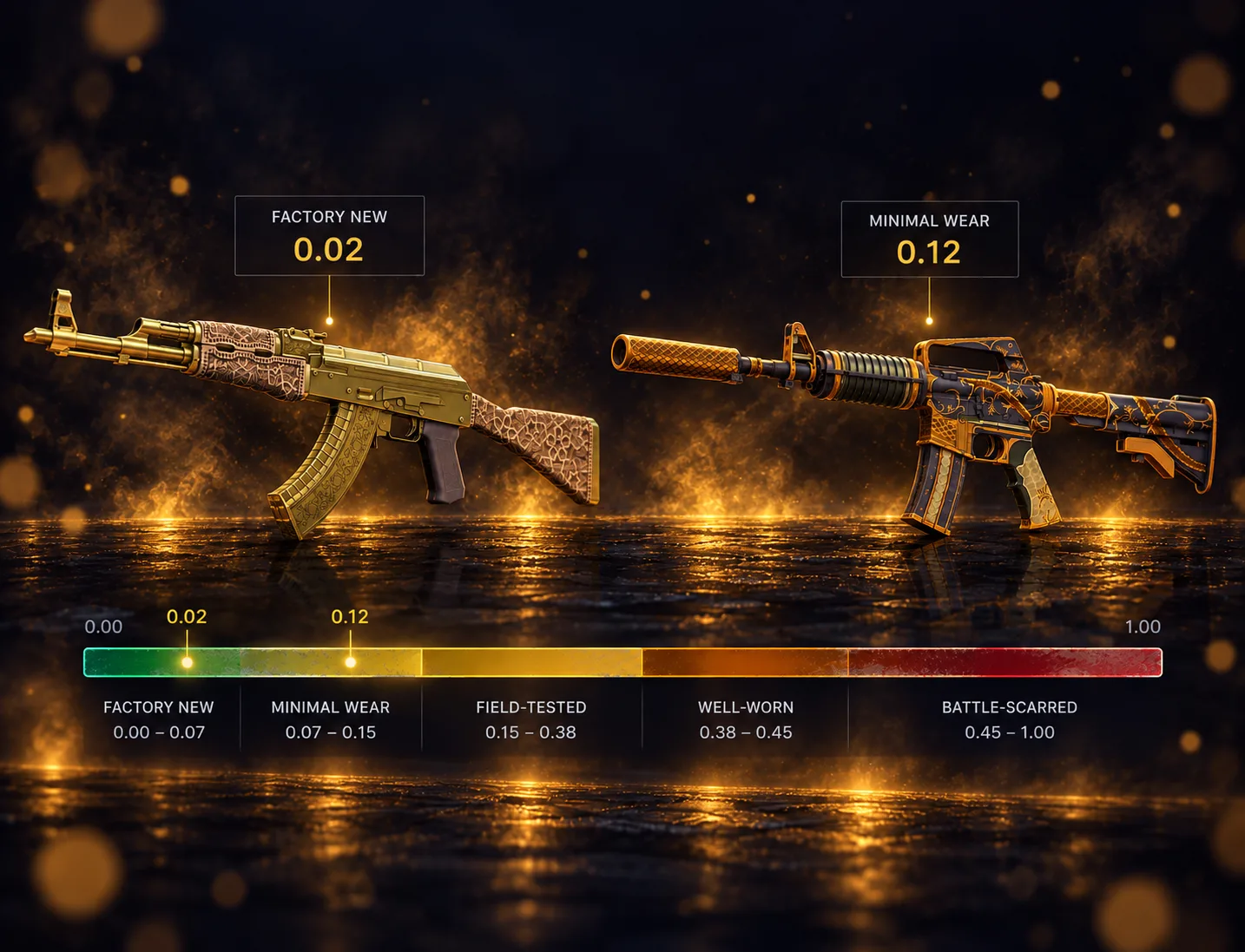
The number usually falls somewhere between 0.00 and 1.00.
Lower float = less wear
Higher float = more wear
The float is assigned when the item is created and does not change afterwards.
Using the weapon in matches does not make the skin more worn. A 0.18 float skin will remain 0.18 regardless of how much you use it.
Float influences how the skin's finish appears in game, although the visual effect varies between different finishes and weapon models.
The five CS2 wear tiers
The familiar condition names are ranges within the float scale.
| Wear tier | Float range |
|---|---|
| Factory New | 0.00 – 0.07 |
| Minimal Wear | 0.07 – 0.15 |
| Field-Tested | 0.15 – 0.38 |
| Well-Worn | 0.38 – 0.45 |
| Battle-Scarred | 0.45 – 1.00 |
The wear label does not tell you exactly where the skin sits inside that range.
For example:
A 0.16 Field-Tested skin sits very close to the Minimal Wear boundary.
A 0.37 Field-Tested skin sits close to Well-Worn.
Both are officially Field-Tested, but they may look noticeably different.
Why float can affect the price
For some skins, float has very little impact beyond the normal wear category.
For others, it can significantly affect market value.
Low floats within a wear tier
A skin near the lower end of its condition can often look considerably cleaner.
For example, buyers may prefer a 0.16 Field-Tested skin over a 0.30 example of the same item.
On skins where wear is visually noticeable, cleaner examples can command a premium.
Very low Factory New floats
Extremely low floats can become collectible.
A normal Factory New skin may already look clean, but examples with values such as 0.001 or 0.0001 can attract collectors because of their rarity.
The exact premium depends heavily on the skin.
Extremely high Battle-Scarred floats
The opposite also exists.
Some collectors look for skins with float values extremely close to 1.00.
Certain finishes can also develop unusual or desirable appearances at very high wear levels.
Float and pattern together
Float is not the only thing that can affect how a skin looks.
Some skins also have a pattern index, and the combination of pattern and float can make two examples of the same skin look very different.
Where scratches, fading or exposed material appear can vary depending on the finish.
Not every skin can reach every condition
Different skins have different permitted float ranges.
A skin might, for example, only exist between:
0.00 and 0.50
or:
0.06 and 0.80
This means some finishes cannot exist in every wear category.
If a particular skin has no Factory New version, it may simply be because its minimum possible float is above the Factory New range.
Likewise, some skins can never reach the highest Battle-Scarred values.
How to compare floats before buying
Do not look only at the wear label.
Compare the actual float value.
Instead of searching simply for:
Field-Tested
you might decide you want:
Field-Tested below 0.20
That gives you a much more useful way to compare listings.
On Skins Dojo, the float value is shown alongside the item's wear condition so you can compare the actual wear number rather than judging only from the category name.
Does a lower float always mean a better skin?
Not necessarily.
For most normal skins, lower floats are generally considered cleaner and more desirable.
But there are exceptions.
Some Battle-Scarred skins are specifically valued because heavy wear creates a distinctive appearance. Certain patterns can also matter much more than a small float difference.
Float should be treated as one part of an item's value alongside:
- the skin itself
- the wear category
- pattern
- stickers
- rarity
- current market demand
The short version
- Float is a fixed wear value, usually between 0 and 1.
- Lower values generally mean less visible wear.
- The five wear conditions are ranges within the float scale.
- Two skins in the same wear category can still look noticeably different.
- Low or extreme floats can carry a premium on certain skins.
- Some skins have restricted float ranges and cannot exist in every condition.
- Compare the actual float value, not just the wear label.